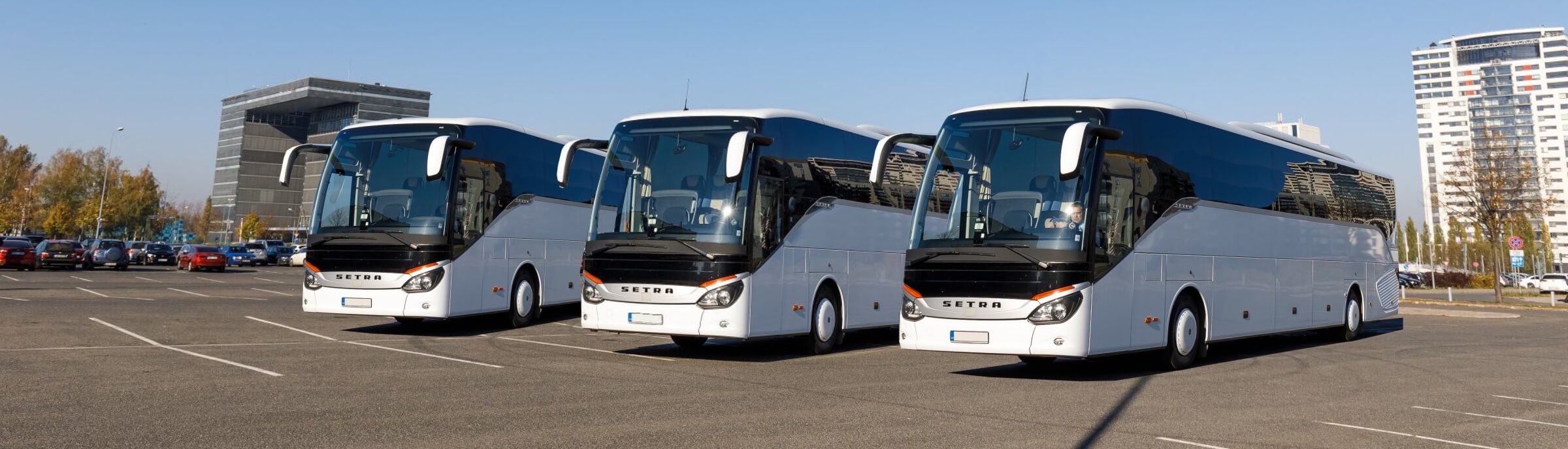
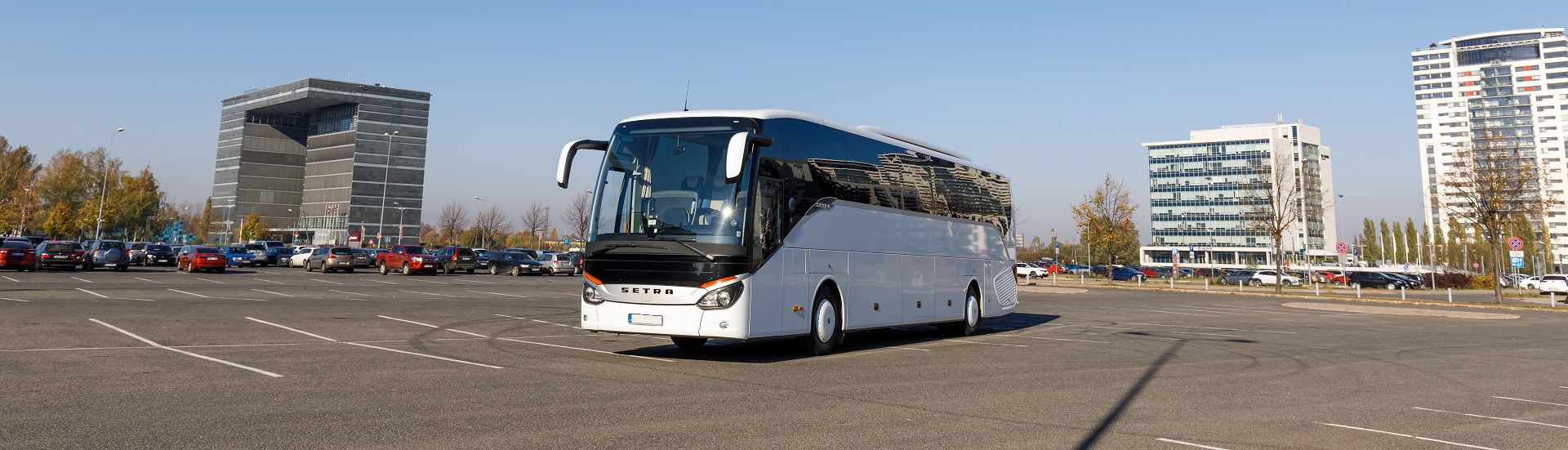
Moving 100 or more people from one place to another sounds like a logistical nightmare. It is not. After coordinating thousands of large-group transfers across Europe, we can tell you it stays manageable as long as you plan it properly. The trouble starts when people improvise.
This guide pulls together what we have learned from over a decade of charter bus hire for conferences, corporate events, weddings, sports tournaments and music festivals. No filler, just the steps that actually matter on the day.
Start Planning 6–8 Weeks Ahead
The biggest mistake large-group organisers make is starting too late. For 100+ people, you need a minimum of 6 weeks lead time. During peak season (May through October), aim for 8–12 weeks.
Why so early? Because group transport on this scale needs more than one vehicle. A standard touring coach seats 49–57 passengers, so 100 people need at least two coaches. Both have to be free on the same date, out of the same depot, ideally with drivers who have worked together before.
Here is a realistic timeline:
- 8 weeks out: Request quotes, confirm vehicle availability, lock in your booking with a deposit.
- 6 weeks out: Share your detailed itinerary. Pick-up points, drop-off points, times, any special stops.
- 3 weeks out: Confirm final headcount. This is when you can still adjust vehicle sizes without penalty.
- 1 week out: Share your passenger list, emergency contacts, and any last-minute itinerary changes.
- Evening before: You receive driver names and mobile numbers. Share these with your group coordinators.
Booking early also gets you a better price. Last-minute bookings of this size cost more, because operators have to pull vehicles off other jobs or subcontract at premium rates.
Calculate Your Vehicle Needs
This is where most people get the maths wrong. You cannot just divide your headcount by a coach’s seat count and call it done.
Rule of thumb: plan for 85% occupancy. If a coach has 57 seats, plan for 48–50 passengers per vehicle. The spare seats soak up last-minute additions, let people spread out with bags and jackets, and cover you if someone turns up with an unexpected plus-one.
For 100 people, here are your typical options:
- 2 touring coaches (49–57 seats each): The most common and flexible setup. Each coach runs on its own, which helps when your group splits for different activities.
- 1 double-decker (up to 75 seats) + 1 midibus (20–30 seats): Cost-efficient for groups that stay together. The double-decker carries the bulk and the midibus mops up the overflow.
- 3 midibuses (30–35 seats each): Better for city centres with narrow streets, or venues with limited coach parking. Three smaller vehicles park more easily than two large ones.
For groups of 150+, we usually recommend 3 full coaches. For 200+, we put a dedicated fleet coordinator on our side who runs every vehicle as one operation.
Always round up, never down. The price gap between a 49-seat and a 57-seat coach is small. The price of scrambling for a third vehicle at the last minute, because you were 5 people short on your estimate, is not.
Airport Arrivals: Stagger Your Pickups
If your 100+ group is flying in, do not assume everyone will walk out of the terminal together. Even on the same flight, passport control, baggage claim and customs can spread arrivals over 30–60 minutes.
Here is what works:
- Appoint a ground coordinator. One person at the airport with a phone, a sign, and a clear meeting point. This person counts heads and communicates with the drivers.
- Stagger departure times. Send the first coach off when it is 80% full, then let the second fill up. Do not leave 50 people standing around for 45 minutes while you wait on the last 10.
- Use a group chat or broadcast list. Send the meeting point, a photo of where to go, and the coordinator’s phone number. People check their phones the moment they land, so use that.
- Pre-position the coaches. At big European airports like Frankfurt, Munich, Amsterdam Schiphol or Barcelona El Prat, coach parking is not right outside the terminal. Coaches sit in designated bays a 5–10 minute walk away, and your coordinator needs to know exactly where.
If your group lands across several flights, book a separate smaller vehicle (a minibus or van) for the early or late airport transfers instead of keeping a full coach waiting for hours. It is cheaper, and more comfortable for everyone.
Hotel–Venue Shuttles: Fixed Loops vs On-Demand
Once your group is at the hotel, you will usually need transport to a venue: a conference centre, a dinner location, or an activity. For 100+ people, you have two models to choose from.
Fixed Loop Shuttle
The coaches run to a set timetable: depart the hotel at 08:00, 08:30 and 09:00, return from the venue at 17:00, 17:30 and 18:00. This suits conferences and structured events where people need to arrive within a window.
Advantage: predictable, easy to communicate, and drivers can plan their breaks. Disadvantage: less forgiving for people who want to leave early or stay late.
On-Demand Service
The coaches wait at the hotel and the venue, leaving when full or when the coordinator gives the signal. This suits social events like gala dinners or team-building days where departure times stay loose.
Advantage: flexible. Disadvantage: you need a coordinator at each end, and drivers rack up waiting time, which you pay for.
For most events we recommend a mix: run fixed loops for the main transfers, and keep one minibus on standby for stragglers. It gives you the best balance of cost and convenience.
Multi-Day Events: Same Driver Continuity
If your event runs over several days, ask for the same drivers throughout. This is not just a nice touch. It makes a real difference to how your transport runs.
A driver who handled your airport pickup on day one already knows your group’s pace, your coordinator’s face, and the route to the venue. He knows Coach 1 always leaves five minutes late because of the group on the third floor. He knows which hotel exit the coaches should wait at.
The same faces also build trust. By day two, your group knows the driver by name and feels looked after. For corporate events, that kind of personal service reflects well on the organiser.
At Bus-service, the same drivers stay with multi-day bookings as standard. If a change is unavoidable, through illness or driving-hour limits, we brief the replacement driver on everything from the previous days.
Your Communication Plan
With 100+ people, communication is the difference between a smooth day and chaos. Here is the approach we recommend to every client:
- Create a group chat (whichever app your group already uses) specifically for transport updates. Post all departure times, meeting points, and any changes here.
- Share driver contact details the evening before. Each coach should have a designated number. Post this in the group: “Coach 1, Driver Marco, +49 170 XXX XXXX. Coach 2, Driver Elena, +39 333 XXX XXXX.”
- Assign a transport coordinator from your team. This person is the one point of contact between your group and the bus company. No logistics expertise required, just a phone, some patience, and clear instructions.
- Send a transport briefing the night before. A simple message: “Tomorrow: coaches depart from the hotel main entrance at 08:15 sharp. Look for the two white coaches with Bus-service logos. Luggage goes in the hold, so please be at the coach by 08:00 to load. Contact Maria (your coordinator) if you have any questions.”
This takes 10 minutes to set up and heads off most of the confusion that crops up on the day.
Luggage Considerations
Luggage is the most underestimated factor in large-group transport. A standard touring coach has two large underfloor compartments that hold roughly 50–60 standard suitcases. That sounds like plenty for 50 passengers, until you remember that some people bring two bags, others have oversized roller cases, and someone always turns up with a box of conference materials or a set of golf clubs.
Ask about luggage upfront. When you collect your headcount, ask whether people will have checked luggage. For airport transfers and multi-day trips, assume one large suitcase plus one carry-on per person.
If your group travels with bulky kit, such as musical instruments, sports gear, exhibition stands or AV equipment, tell us at the quoting stage. We may need a vehicle with extra hold space, or a luggage trailer. It is far cheaper to arrange in advance than to fix on the day.
For day trips and shuttle runs where people carry only small bags, luggage is rarely an issue. But for anything involving suitcases, plan for it on purpose.
Budget: What’s Included and What’s Extra
For a group of 100 people on two touring coaches, a typical all-day charter in Western Europe runs between €1,600 and €3,000 in total. That works out at €16 to €30 per person per day. Set that against taxis, rental cars or train tickets for the same number of people and the maths speaks for itself.
What is included in a standard Bus-service quote:
- Professional driver(s), fully licensed, experienced, English-speaking
- Fuel for the entire journey
- Motorway tolls, tunnel fees, bridge crossings
- Coach parking at venues
- Vehicle insurance and passenger liability
- VAT and all applicable taxes
- Driver accommodation for multi-day bookings
What may be extra:
- Waiting time beyond the agreed schedule. If your event runs two hours late, the driver stays, but overtime applies. Usually €40–60 per hour per vehicle.
- Overnight parking in city centres. Some cities charge €30–80 per night for coach parking. We fold this into the quote when we know the location.
- Environmental zones and city entry fees. Cities such as London (ULEZ), Brussels (LEZ) and Amsterdam run low-emission zones with entry charges. Our Euro VI fleet meets the standards, but some cities still charge a registration fee.
- Ferry crossings if your route includes one (e.g., Dover–Calais).
The principle is simple: the invoice should hold nothing you did not see coming. A good charter company quotes all-inclusive and flags anything extra before you book, not after.
Hard-Won Tips from the Road
After more than 10 years of running large-group charters across Europe, here are the things we wish every organiser knew.
Number your coaches. Put a clear “Coach 1” and “Coach 2” sign in the windscreen and tell people which one they are on. It sounds trivial, but it saves the 10-minute shuffle when two identical white coaches are parked side by side.
Build in buffer time. If your conference starts at 09:00 and the venue is 20 minutes from the hotel, do not schedule the coach for 08:40. Schedule it for 08:15.
Large groups are slow to board. Someone will forget something in their room. A 15-minute buffer costs nothing but saves you enormous stress.
Feed your drivers. On a long day, a driver who gets a meal voucher or a place in the catering order will look after you in return. It is not required, as drivers carry their own provisions, but it gets noticed. It costs €15 and buys you a lot of goodwill.
Confirm the parking situation at your venue. Not every venue has coach parking. Conference centres in city centres are particularly tricky.
Give us the venue address at the quoting stage and we will check the parking. If there is no coach parking, the driver has to drop off and come back later, which changes both the schedule and the cost.
Have a plan for no-shows. With 100 people, someone will always miss the bus. Decide in advance: does the coach wait 5 minutes, or does the person take a taxi?
Communicate this clearly the night before. “Coaches depart at 08:15. If you are not on board by 08:15, please take a taxi to the venue and expense it.”